Golden Retriever vs Standard Poodle: Shedding, Lifespan & Grooming
Compare Golden Retriever vs Standard Poodle on shedding, grooming cost, lifespan, trainability, and family fit to find the right large breed for your home.
Updated

Quick Verdict
Better fit for families with kids
Golden Retriever
Golden Retriever: Gentle with young childrenStandard Poodle: Best with older, active childreniGenerally good with children; their attentiveness and gentle nature suit family life well, though socialisation and adult supervision around young kids are always recommended
Both beginner-friendly, with different tradeoffs
Golden Retriever: Beginner-friendlyStandard Poodle: Beginner-friendly
Similar for both
Golden Retriever: Gentle nature; usually excellentiSoft-mouthed retriever temperament and low prey drive make Golden Retrievers among the better large breeds for cat households; early introduction removes most of the risk and coexistence is typically smoothStandard Poodle: Adaptable; usually goodiIntelligent and socially adaptable; Standard Poodles generally adjust well to cats given proper introduction — low-to-moderate prey drive makes coexistence manageable in most households
Neither ideal
Golden Retriever: Needs committed daily routineiSize and activity needs are significant; possible with a very active owner who provides daily outdoor exerciseStandard Poodle: Needs committed daily routineiSize and high energy require significant daily exercise; possible with a very active owner and consistent outdoor routine, but homes with outdoor access are better suited
Verdicts are based on trait ratings. Always evaluate individual dogs and confirm behavior with the shelter, foster, or rescue organization.
Stats at a Glance
| Trait | Golden Retriever | Standard Poodle |
|---|---|---|
| Size | Large | Large |
| Energy | Moderate to High | High |
| Shedding | Very High | Low |
| Grooming | High | High |
| Trainability | Very High | Very High |
| Barking | Low to Moderate | Low to Moderate |
| Apartment Friendly | Possible (daily exercise required) | Possible (daily exercise required) |
| Good With Kids | YesGentle with young children | OftenBest with older, active children |
| Good With Dogs | Often | Often |
| Good With Cats | Often with socializationGentle nature; usually excellent | Often with socializationAdaptable; usually good |
| Daily Exercise | 60–90 min/day | 60–90 min/day |
| Typical Lifespan | 10–12 years | 12–15 years |
| Beginner Friendly | Beginner-friendly | Beginner-friendly |
The Golden Retriever and Standard Poodle are two of the most consistently recommended large breeds for families and first-time owners, and for good reason: both are highly trainable, friendly, low-barking dogs with manageable temperaments. On several dimensions they are nearly identical, including exercise needs, trainability, beginner-friendliness, and apartment suitability. The real differences are shedding, grooming cost structure, lifespan, and kids compatibility, and these are the factors that tend to drive the decision between them.
Main difference: The Golden Retriever sheds Very High and is managed primarily at home; the Standard Poodle sheds Low but requires professional clipping every 6–8 weeks as a permanent ongoing cost. The Poodle also lives 2–3 years longer on average.
Who should choose each breed?
Choose a Golden Retriever if
- You want a breed with a universally documented tolerance for young children, including toddlers, with no extra management required for temperament
- You prefer to handle grooming at home rather than commit to regular professional appointments, even at the cost of significant loose fur year-round
- Your household already accepts dog fur as part of daily life, and you are prepared to brush and deshed consistently rather than pay for professional clips
- You want a breed with deeply established family-dog temperament: soft, affectionate, and highly forgiving of handling variation
Choose a Standard Poodle if
- You want a large breed that sheds minimally and leaves almost no loose fur on furniture, clothing, or floors
- You are prepared to budget for professional grooming every 6–8 weeks as a fixed ongoing cost, and prefer that to year-round heavy home brushing
- Lifespan is a meaningful factor in your decision: the Poodle's 12–15 year median is 2–3 years longer than the Golden's 10–12 years
- Your household includes older, active children who can engage with a higher-energy, more athletic companion
Size and build
Both breeds are in the Large size class. The Golden Retriever is typically 55–75 pounds and 21–24 inches at the shoulder, with a broad, sturdy build: dense double coat, floppy ears, and the rounded, expressive face that makes it one of the most visually recognizable breeds. The Standard Poodle is typically 40–70 pounds and 18–24 inches at the shoulder, with a more athletic and angular frame: long legs, a narrow muzzle, and a curly or wavy single coat that does not shed.
The practical size difference is minimal. Both breeds are equally present in the home, both require leash control, and both need outdoor space for exercise. The Golden's broader build and heavier coat can make it feel physically larger in day-to-day life. The Poodle's lighter frame gives it an athletic quality that translates to higher activity drive, which is reflected in its High energy rating versus the Golden's Moderate-High.
Temperament and personality
The Golden Retriever's temperament is one of the most documented and consistent of any breed: soft-mouthed, highly social, affectionate, and oriented toward the household at all times. Its retriever background produces a breed that is fundamentally motivated by connection, responsive to emotional cues, and tolerant of handling variation including rough or unpredictable contact from young children. Golden Retrievers are not passive dogs; they are active, curious, and genuinely engaged. But their intensity is calibrated toward warmth rather than assertion.
The Standard Poodle is equally intelligent and socially engaged, but its temperament has a different quality: more active, more attentive to its environment, and more assertive in its engagement. Poodles were working retrievers bred for high-output water retrieving; the intelligence that makes them so trainable also means they are perceptive, quick-reacting, and easily under-stimulated if not properly engaged. A Standard Poodle that is well-exercised and mentally active is a composed, attentive companion. One that is under-stimulated can become vocal, restless, or destructive.
Both breeds share Moderate alone-time tolerance. Neither should be left alone for extended hours without appropriate conditioning, and both bond closely enough to their households that long-term isolation is a genuine welfare concern.
Exercise and stimulation needs
Exercise needs are identical on paper: both breeds need 60–90 minutes of real daily activity. In practice, the Standard Poodle's High energy rating means its activity needs are more demanding and less negotiable than the Golden's Moderate-High. The Poodle benefits from sustained, purposeful exercise, including off-leash running, retrieving, swimming, or structured play, rather than slow walks. The Golden Retriever is more adaptable: it thrives with vigorous exercise but handles moderate-pace routines well when the rest of its needs are met.
Mental stimulation is a genuine requirement for both breeds, not an optional extra. Both were bred to work, and idle, under-challenged dogs from either breed will find occupation on their own terms. Puzzle feeders, structured training sessions, and interactive play are standard management tools for both, and Standard Poodle owners often find that meeting the mental stimulation need reduces the energy demand more than any amount of additional walking alone.
Shedding and grooming
This is the most significant practical difference between these two breeds.
The Golden Retriever sheds Very High. Its dense double coat produces loose fur year-round and substantially more during seasonal shedding peaks in spring and autumn. Furniture, clothing, car seats, and any porous surface in the home will carry golden fur. Managing this requires consistent brushing, three to four times per week as a baseline, daily during peak shedding, plus a good deshedding tool and occasional professional deshedding treatments. Many owners also take Goldens for professional baths and trims a few times per year, though this is not strictly required by the coat type.
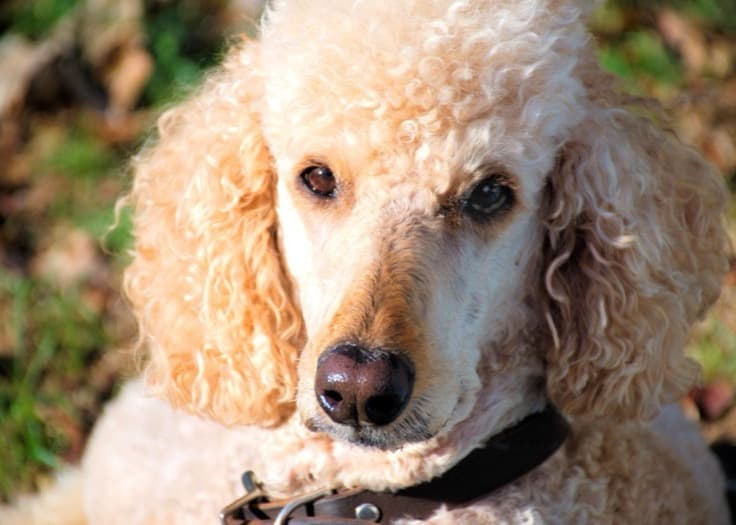
The Standard Poodle sheds Low. Its single curly coat traps dead hair rather than releasing it, which means almost no loose fur in the home. This is a genuine quality-of-life difference for people with sensitivities to pet hair or who simply do not want fur on everything they own. The trade-off is mandatory professional grooming. The Poodle's coat grows continuously and mats quickly without consistent care; professional clipping every 6–8 weeks is not optional, and the coat must be brushed daily between appointments to prevent tangles. Letting the coat grow without maintenance creates painful matting that often requires a full shave-down to correct.
Neither coat type is low-maintenance. The choice is between labor-intensive home care with high fur output, versus lower home effort with a recurring professional grooming bill.
Training and behavior
Both breeds are rated Very High for trainability, which places them in the top tier of working intelligence across all breeds. The training experience with each is notably similar: both pick up new behaviors quickly, retain them reliably, and engage willingly with reward-based sessions. Problem behaviors in either breed are usually addressable with consistency, and neither has the selective or stubborn streak common in herding or terrier breeds.
The behavioral difference that matters is energy expression. The Golden Retriever's Moderate-High energy produces a dog that is enthusiastic and playful but generally settles when physical needs are met. The Standard Poodle's High energy means its need for engagement continues after physical exercise. Poodles are easily bored and show it, and an under-stimulated Poodle can become more demanding, vocal, or destructive than a Golden in the same circumstances.
Both breeds are rated Low-Moderate for barking, which is meaningfully quiet for large breeds. Neither is a reliable watchdog in the alert-barking sense.
Apartment and family fit
Which is better for apartments?
Both breeds are rated Possible (daily exercise required). Neither is ideally suited to apartment living at this size. The Golden Retriever's Moderate-High energy and 60–90 minute daily exercise requirement is significant but manageable with a committed owner and nearby park access. The Standard Poodle's High energy makes the commitment more demanding, not less; it needs more sustained, vigorous activity to settle properly indoors.
Barking is not a differentiator: both rate Low-Moderate, which is relatively quiet for large breeds and unlikely to create serious conflict in shared-wall buildings. The limiting factor for both breeds in apartments is size, daily exercise commitment, and indoor restlessness when needs are not met. Owners with dogs in this pairing who live in apartments consistently report that the exercise routine needs to be non-negotiable for indoor life to work. See Best Dogs for Apartments for a fuller picture of what apartment suitability requires.
Which is better for families with kids?
The Golden Retriever is rated Yes; the Standard Poodle is rated Often, with the note "Best with older, active children." The Golden's documented tolerance across age groups, including toddlers and young children still learning appropriate handling, is the real advantage here. The Poodle's higher energy and more assertive physical presence suit older children who can match its activity level and engage it appropriately.
Both breeds are good family dogs. The gap is most relevant when the household includes young children who may handle dogs unpredictably. The Golden is more forgiving in that scenario. The Poodle suits families where children are old enough to be active play partners. See Best Dogs for Families for broader context on what makes a breed a good family match.
Cost comparison
These are planning ranges. Regional variation, adoption source, insurance, and individual health history all affect actuals.
| Cost area | Golden Retriever | Standard Poodle |
|---|---|---|
| Food (monthly) | $65–$90 | $65–$90 |
| Grooming upkeep (monthly avg) | $25–$55 | $65–$95 |
| Routine vet care (monthly avg) | $45–$75 | $45–$75 |
| Preventatives | $25–$50 | $25–$50 |
| Estimated ongoing monthly range | $160–$270 | $200–$310 |
The grooming cost gap of approximately $40–$50 per month is the largest structural budget difference between these breeds. Golden Retriever grooming is primarily a home labor cost, plus optional professional baths and trims a few times per year. Standard Poodle grooming is a fixed professional expense: clipping every 6–8 weeks at $90–$140 per appointment in most markets, plus daily home brushing. Golden Retrievers also have documented higher-than-average health costs over their lifetimes due to breed-specific health vulnerabilities, which can offset the grooming savings depending on individual health history.
For broader budgeting guidance, see How Much Does a Dog Cost Per Month? or use the Monthly Cost Calculator for a personalized breakdown.
Final decision: Golden Retriever or Standard Poodle?
The Golden Retriever and Standard Poodle are close enough on most dimensions that the decision often comes down to one question: how do you feel about fur on everything you own, versus a recurring professional grooming bill? If loose fur is a quality-of-life problem and you are willing to pay for professional clips on a fixed schedule, the Standard Poodle wins clearly on shedding and lifespan. If you prefer to handle coat care at home and accept the fur as part of the deal, the Golden Retriever's softer temperament and wider kids compatibility give it the edge for most family households.
Choose the Golden Retriever if you want the most universally family-compatible, fur-shedding large breed with a forgiving temperament. Choose the Standard Poodle if low shedding, longer lifespan, and an athletic companion for older children are your priorities.
These profiles describe trait patterns that apply to any dog you are evaluating, at a shelter, through a rescue organization, or in a foster placement. Golden-type and Poodle-type characteristics appear across many dogs regardless of documentation. If you are evaluating a dog in person, the shedding, grooming, and temperament markers in this comparison remain useful reference points. The Adoption Readiness Guide can help you prepare for that process.