Rottweiler: Temperament, Care & Lifespan
Learn about Rottweiler temperament, protective instincts, training requirements, and whether this powerful guardian breed is the right fit for your household.
Updated
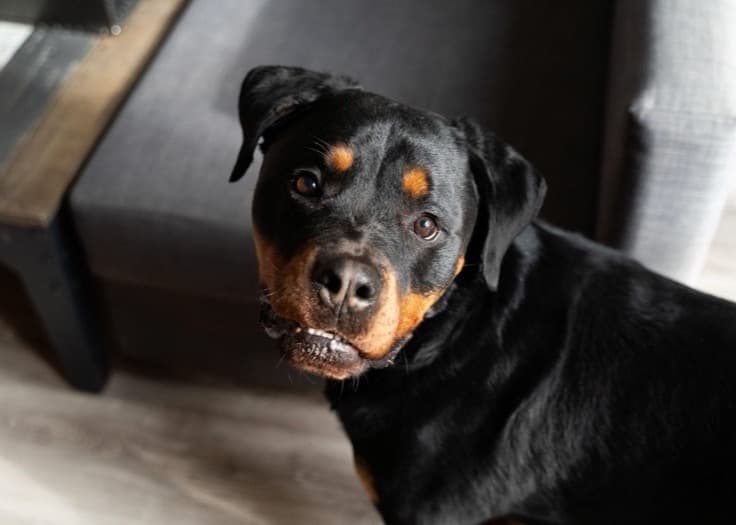
Stats at a Glance
- Size
- Large
- Energy
- Moderate
- Shedding
- Moderate
- Trainability
- High
- Apartment
- Possible (daily exercise required)i
- Size and training commitment needed
- Grooming
- Low to Moderatei
- Barking
- Low to Moderate
- Exercise
- 60–90 min
- With Kids
- Dependsi
- Experienced handling needed
- With Dogs
- Dependsi
- Early socialization needed
- With Cats
- Dependsi
- Early intro essential
- Origin
- Germany
Trait Score Snapshot
| Trait | Score |
|---|---|
| Energy | ★★★☆☆3/5 |
| Shedding | ★★★☆☆3/5 |
| Barking | ★★☆☆☆2/5 |
| Grooming demand | ★★☆☆☆2/5 |
| Trainability | ★★★★☆4/5 |
| Apartment suitability | ★★★☆☆3/5 |
| Beginner friendliness | ★★☆☆☆2/5 |
Rottweilers are large working dogs with a natural guarding instinct, developed in Germany as cattle drovers and later as protection and police dogs. They are powerful, self-confident, and deeply bonded to their families — a combination that makes them either a highly rewarding companion or a poor fit, depending almost entirely on how prepared and experienced the owner is.
This is not a casual or low-maintenance breed. Rottweilers need structured obedience training from the start, ongoing socialization, and an owner who can provide consistent leadership without harshness. They are more emotionally sensitive than their physical presence suggests — they respond poorly to rough or aversive handling and do best with firm, fair, positive-reinforcement approaches.
This guide is informational and not veterinary advice. Consult a licensed veterinarian for medical concerns.
Bottom line: A Rottweiler is a strong fit for experienced owners who want a loyal, protective dog and are prepared to invest in training and socialization from day one. It is a poor fit for first-time owners, low-structure households, or anyone not ready to manage the strength and protective instincts of a large working breed.
Size & lifespan
Most adult Rottweilers weigh 80–135 pounds, depending on sex and build, and stand approximately 22–27 inches tall at the shoulder.
The average lifespan is typically 8–10 years, which is common for large breeds.
History & origin
The Rottweiler takes its name from the German town of Rottweil, where Roman legions brought large cattle-driving dogs during their occupation of Germania. Over centuries, the local working population used these dogs to drive cattle to market and pull butcher's carts — earning the breed the nickname Rottweiler Metzgerhund (Rottweil butcher's dog).
As rail transport replaced cattle drives in the 19th century, the breed nearly disappeared. A revival effort in the early 20th century redirected the Rottweiler toward police work, military service, and personal protection — work the breed took to naturally given its intelligence, strength, and trainability.
The AKC recognized the Rottweiler in 1931. Today the breed sits consistently among the most registered in the United States, though that popularity has also made it one of the more misunderstood — and, in some jurisdictions, subject to breed-specific legislation.
Lifestyle fit
- Apartment Living: Possible with consistent daily exercise and strong obedience training — but size and strength raise the bar significantly
- First-Time Owners: Not recommended — protective instincts and physical strength require confident, experienced handling
- Families with Kids: Possible in structured households with experienced guidance and consistent socialization
- Active Households: Strong fit
- Low-Energy Homes: Poor fit — daily structured activity is required
- Seniors: Not a natural fit — strength and training demands are difficult to manage for most seniors
Quick take: Is a Rottweiler right for you?
Pros
- Natural loyalty and protectiveness toward family
- Trainable with competent handling — excels in obedience, working sports, and service roles
- Calm and steady indoors when adequately exercised
- Moderate grooming demands for a large breed
Cons
- Requires experienced, consistent handling from day one
- Physical strength makes training non-negotiable, not optional
- Protective instincts need active socialization to remain appropriate
- Shorter lifespan than many breeds (8–10 years)
- Potential legal/insurance implications in some jurisdictions (BSL)
Best for
- Experienced dog owners
- Households seeking a confident, loyal companion
- Owners committed to structured training
- Homes with clear routines and boundaries
Not ideal for
- First-time owners unprepared for firm leadership
- Homes without time for early socialization
- Sedentary households
- Owners uncomfortable managing a powerful breed
What living with a Rottweiler is actually like
A well-exercised, well-trained Rottweiler is a surprisingly calm house dog. They are not high-strung or bouncing-off-the-walls; they tend to settle, watch, and reserve their energy. The day-to-day experience is often described as living with a large, loyal, quietly attentive companion — one who is deeply bonded to the household and watchful of anything outside it.
That calm is earned, not automatic. It requires daily structured exercise, consistent obedience work (ongoing, not just puppy class), and socialization that continues well past adolescence. Owners who invest in this from the start typically describe their Rottweiler as one of the most rewarding dogs they've owned. Owners who underestimate the foundation work describe a different experience entirely.
The breed's sensitivity is often underestimated. Rottweilers read their owner clearly and respond to tone, mood, and consistency. Harsh handling creates anxiety and unpredictability; calm leadership produces stability. This is not a dog you can overpower into compliance — but it is a dog that genuinely wants to work with you when the relationship is right.
Temperament & personality
Rottweilers are often described as confident, composed, and watchful.
Naturally protective
Many Rottweilers display protective tendencies toward their family. This instinct can be an asset when properly managed, but requires early and consistent socialization to prevent inappropriate guarding.
Calm but powerful
Compared to highly reactive breeds, Rottweilers often appear steady and deliberate. They tend to conserve energy and respond thoughtfully rather than impulsively.
Loyal and bond-focused
Rottweilers frequently form strong attachments to their owners and prefer staying close to their household members.
Compared to the more alert and high-reactivity style of the German Shepherd, Rottweilers often show a heavier, more grounded temperament.
Exercise needs: How much activity does a Rottweiler need?
Most adult Rottweilers benefit from 60–90 minutes of structured daily activity, combining physical exercise with controlled mental engagement.
A balanced routine may include:
- Brisk walks
- Structured obedience sessions
- Controlled fetch or tug
- Confidence-building exposure work
Structured exercise vs. chaotic excitement
Rottweilers generally benefit more from controlled, rule-based activity than chaotic play. Calm leadership during exercise reinforces stability.
Signs of insufficient engagement
- Restlessness
- Escalating guarding behavior
- Destructive chewing
- Excessive territorial alertness
Consistency matters more than extreme intensity.
For other strong working breeds: High-Energy Dog Breeds
Shedding & grooming
Rottweilers have short double coats that are relatively low-maintenance.
Shedding expectations
- Moderate year-round shedding
- Seasonal increases possible
Grooming routine
- Weekly brushing
- Occasional bathing
- Regular nail trimming
- Routine ear checks
Grooming demands are lower than long-coated breeds like the Golden Retriever.
Training & behavior
Training is essential for this breed.
Training difficulty
Trainable under competent, consistent leadership — but training quality matters more for a Rottweiler than for many breeds. Their strength, guarding instincts, and sensitivity to handling mean sloppy or harsh training produces poor outcomes that are difficult to reverse.
Common behavior challenges
- Territorial guarding if poorly socialized
- Pulling on leash due to strength
- Same-sex dog intolerance in some individuals
- Overconfidence without boundaries
Practical training tips
- Begin structured training early.
- Prioritize neutral exposure to people and environments.
- Reinforce calm, non-reactive behavior.
- Maintain consistent household rules.
Strong leadership paired with positive reinforcement produces the most stable outcomes.
Are Rottweilers aggressive?
Rottweilers are sometimes labeled aggressive, but behavior depends heavily on genetics, socialization, training, and environment.
Many well-trained Rottweilers are stable, calm, and confident. Poor socialization or inconsistent leadership increases risk of problematic behavior in any protective breed.
Responsible ownership is critical.
Are Rottweilers good family dogs?
Rottweilers can be devoted family companions in structured households. Many are affectionate and protective of children within their home.
However:
- Supervision is important.
- Early socialization is essential.
- Experienced handling improves outcomes.
This breed is best suited for families prepared for consistent training.
For more family-suited breeds: Best Dogs for Families
Are Rottweilers good for apartments?
Apartment living may be possible if exercise and training needs are consistently met. However, Rottweilers are large, powerful dogs and often do better in homes with more space.
Apartment suitability depends on:
- Daily structured exercise
- Strong obedience training
- Clear behavioral boundaries
Without these elements, confined spaces can amplify behavioral challenges.
For more apartment-friendly breeds: Best Dogs for Apartments
Adoption, rescue, and foster considerations
A common reason Rottweilers enter rescue is owner underestimation of the training and leadership commitment required. Many arrive with underdeveloped socialization, strong pulling habits, or guarding behaviors that intensified without structure. These are not character flaws — they are outcomes of insufficient ownership.
Adult Rottweilers in rescue who have been fostered offer a real advantage: foster caregivers can describe behavior around strangers, other dogs, and children with direct experience rather than guesswork. For a breed where temperament assessment matters this much, that information is valuable.
Questions to ask the rescue or foster:
- Why was the dog surrendered, and what was the household situation?
- Any history of guarding or resource-guarding behavior?
- Behavior around children and strangers?
- Dog-dog experience, especially with same-sex dogs?
- Any training completed, and what methods were used?
- Any hip, elbow, or cardiac evaluation history?
Searching for Rottweiler-specific rescue organizations is the best starting point; many operate regional networks with experienced evaluators.
Common Rottweiler owner challenges
Physical strength management is the most immediate challenge, particularly on leash. An 80–135-pound dog that pulls is unmanageable for many adults — and dangerous in reactive situations. Leash manners and controlled walking are foundational skills that need to be trained early and reinforced consistently.
Ongoing socialization extends well beyond puppyhood. Rottweilers that receive good puppy socialization but limited continued exposure during adolescence can become selective or reactive by 18–24 months. Socialization is not a phase to complete — it is a practice to maintain.
Legal and insurance implications affect some Rottweiler owners. Breed-specific legislation (BSL) restricts or prohibits Rottweilers in certain municipalities and housing communities. Some homeowners insurance policies exclude them or increase premiums. Prospective owners should verify local regulations and housing policies before acquiring the breed.
Protective instincts without structure can escalate into inappropriate guarding — of food, space, family members, or territory. This is a management and training issue, not an inevitability, but it requires active attention. Consistent obedience work and impulse-control training are the primary tools.
Health considerations
Common health considerations
- Hip and elbow dysplasia
- Osteosarcoma (bone cancer, higher incidence in large breeds)
- Heart conditions (subaortic stenosis in some lines)
Weight & lifestyle risks
Rottweilers carry significant body mass, and even moderate overweight status adds meaningful stress to joints already at elevated risk. Maintaining a lean body condition is especially important for long-term mobility and quality of life in this breed.
Questions to ask your shelter or vet
- Any hip or elbow evaluation history?
- Any cardiac screening history?
- Any signs of lameness, limb favoring, or reduced activity tolerance?
- What is the current weight and body condition score?
Consult a veterinarian for medical advice specific to your dog.
Cost to own a Rottweiler
Training is the non-negotiable cost driver for this breed. A Rottweiler that isn't consistently trained develops problem behaviors that are expensive and difficult to remediate. Budget for structured puppy obedience, intermediate obedience, and ideally an advanced class or working sport as the dog matures. Professional training costs for a large protective breed run higher than for most dogs — group classes alone are often not sufficient.
Health costs are also elevated relative to the average breed. Hip and elbow dysplasia screening and potential surgical or management costs are real considerations. Osteosarcoma, while not universal, is a significant financial and emotional risk — treatment (amputation + chemotherapy) can exceed $10,000. Pet insurance for this breed is worth evaluating before or shortly after acquisition.
Typical annual expense categories:
- Food: $900–1,400/year for a large adult on a quality diet
- Veterinary care: $400–$700/year routine; substantially higher if orthopedic or cardiac issues emerge
- Training: $600–2,000+ across the first two years; ongoing for owners pursuing working sports or advanced obedience
- Durable equipment: Leashes, collars, harnesses, and crates rated for large, strong breeds — standard gear wears out faster
- Pet insurance: Strongly recommended given osteosarcoma risk and joint predisposition
For general budgeting context, see: How Much Does a Dog Cost Per Month?
Similar breeds to research
If you are considering a Rottweiler, these breed profiles may also be worth exploring:
- German Shepherd — similar working-dog intelligence and trainability; more energy and versatility, less physical mass
- Doberman Pinscher — leaner, higher-energy guardian with comparable handler-focus and protective instinct
- Boxer — working/guardian background with a more playful temperament and better fit for some first-time owners
Rottweiler comparison pages
Other comparisons