Catahoula Leopard Dog: Temperament, Prey Drive & Care
Learn about Catahoula Leopard Dog temperament, prey drive, independence, and whether this high-drive Louisiana working breed fits your household.
Updated
Stats at a Glance
- Size
- Large
- Energy
- Very High
- Shedding
- Low to Moderate
- Trainability
- Moderate
- Apartment
- Noi
- Extremely high activity needs
- Grooming
- Lowi
- Barking
- Moderate to Highi
- Exercise
- 90–120+ min
- With Kids
- Yes (with supervision)i
- best with older kids; high energy
- With Dogs
- Varies widelyi
- Same-sex aggression; individual assessment
- With Cats
- Possible with managementi
- High prey drive; individual assessment
- Origin
- United States
Trait Score Snapshot
The Louisiana Catahoula Leopard Dog (often called simply "Catahoula") is a large, high-energy working dog developed in the American South for hog and deer hunting and driving livestock. It is the official state dog of Louisiana. The breed is recognized by the UKC and the AKC Foundation Stock Service.
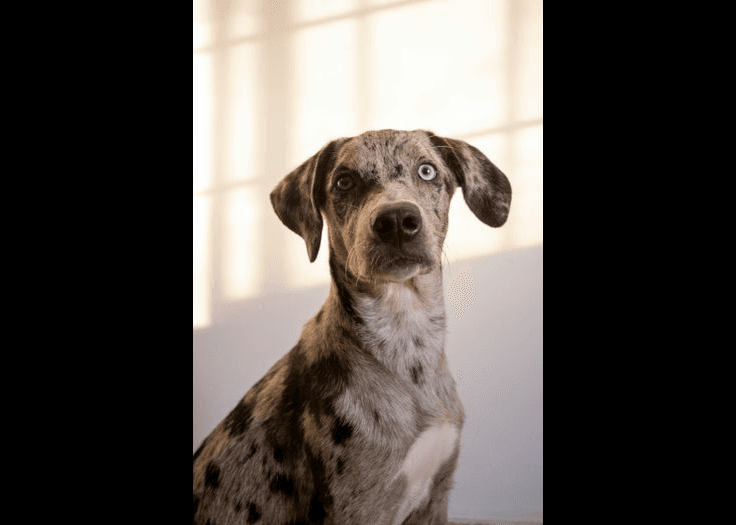
The Catahoula is notable for several physical characteristics: a merle or spotted coat in a wide range of colors, frequently mismatched or pale "glass" eyes, and webbed feet suited to swampy terrain. These traits make it visually striking and frequently admired. The behavioral profile is equally distinctive, and considerably more demanding to manage.
This guide is informational and not veterinary advice. Consult a licensed veterinarian for medical concerns.
Bottom line: A well-matched Catahoula is an athletic, loyal, and fascinating working dog in the right hands. The right hands belong to an experienced owner who can provide intensive daily exercise, structured training, and confident, consistent handling. This is not a breed that self-manages or tolerates under-stimulation quietly.
Size & lifespan
Most adult Catahoula Leopard Dogs weigh 50–95 pounds and stand 22–26 inches at the shoulder. Weight variation across individuals is significant.
The typical lifespan is 10–14 years, average for a large breed.
History & origin
The Catahoula's origins trace to Native American dogs crossed with Spanish war dogs brought to Louisiana by Hernando de Soto's expedition in the 16th century. The resulting working dogs were used by Native Americans and later by European settlers for hunting wild hog and driving livestock, particularly in the challenging swampy terrain of Louisiana.
The breed's name comes from Catahoula Parish, Louisiana, where much of its development occurred. Its hunting and herding background produced an independent, high-drive dog with strong prey and chase instincts and the physical endurance to work long days in difficult conditions.
Lifestyle fit
- Apartment Living: Not suitable; exercise needs and vocalization make apartment living incompatible
- First-Time Owners: Not recommended; independence and drive consistently exceed beginner capacity
- Families with Kids: Experienced households only; not recommended with young children
- Active Households: Strong fit for genuinely active, experienced owners
- Low-Energy Homes: Not compatible
- Seniors: Not recommended; exercise and management demands exceed what most senior owners can sustain
Quick take: Is a Catahoula Leopard Dog right for you?
Pros
- Physically striking and visually unique
- Loyal and devoted to their household
- Versatile working dog capable in hunting, tracking, herding, and dog sports
- Relatively low grooming overhead
- Exceptional athleticism and endurance
Cons
- High prey drive creates management demands with small animals, cats, and fast-moving objects
- Independence makes training more effortful than with eager-to-please breeds
- Same-sex dog aggression is not uncommon
- Not suitable for first-time owners
- Alone-time tolerance is low; prone to separation anxiety
- Vocalization (howling, barking) when under-stimulated
- Wandering and escape instinct requires secure fencing
Best for
- Experienced owners committed to daily vigorous activity and structured training
- Active individuals who hunt, hike, or participate in dog sports
- Rural households with space and secure fencing
- Owners familiar with working-dog behavior
Not ideal for
- First-time owners
- Households with young children
- Apartments or high-density housing
- Multi-dog households without experience managing same-sex dynamics
- Owners who cannot provide consistent daily exercise
What living with a Catahoula is actually like
The Catahoula is an athletic, watchful, and demanding companion. In a household that provides adequate exercise and structured engagement, they are loyal and responsive. They tend to be reserved with strangers and more expressive with their family.
When under-stimulated, the Catahoula expresses its frustration loudly: howling, destructive chewing, escape attempts, and persistent restlessness. This is not a breed that settles without outlet.
The prey drive is always present. Cats, small animals, squirrels, and bicycles can all trigger pursuit behavior that overrides obedience in an unsecured environment. A Catahoula should not be trusted off-leash without a securely enclosed area.
Temperament & personality
Loyal but independent
Catahoulas bond strongly with their family but are not typically velcro dogs. They are watchful, self-possessed, and often reserved with strangers. With their household, they are affectionate on their own terms.
The independence is a working-dog trait: the Catahoula was developed to make field decisions without constant handler guidance. This translates to training contexts as a dog that needs a handler who earns respect rather than simply expecting compliance.
High prey drive
The hunting and herding heritage shows up clearly in daily behavior. The prey drive is strong and broad, triggering on small animals, running objects, and fast-moving stimuli. Management through secure fencing, consistent leash discipline, and recalled training is essential.
Same-sex dog dynamics
Same-sex dog aggression, particularly among males, is a documented tendency in the breed. Early socialization helps, but it does not eliminate the underlying drive. Assess the individual dog's history with other dogs carefully before any multi-dog household placement.
Exercise needs
Most adult Catahoulas need 90–120+ minutes of vigorous daily exercise, with mental stimulation in addition to physical activity.
Activities well-suited to the breed: structured long-distance running or hiking, hunting, tracking and scent work, agility, and off-leash work in a secured area. Walks alone are insufficient.
For other high-energy breeds: High-Energy Dog Breeds
Are Catahoula Leopard Dogs good with kids?
Catahoulas can live with children in experienced households where adults actively manage the dog's interactions, but they are not a natural family dog in the general sense. Their size, high drive, and prey instincts create real management demands around young children who run, shriek, or make fast unpredictable movements.
Older children who understand how to interact calmly with dogs are a better fit than toddlers or very young children. The Catahoula is not a breed that self-regulates or has an inherently tolerant temperament with small humans. Supervision is always necessary, and the household must have the capacity to manage the dog's full exercise and stimulation needs alongside child-raising responsibilities.
Catahoula Leopard Dogs with cats and small animals
Prey drive is not incidental to the Catahoula. It is central to what the breed is. Catahoulas were developed to track, bay, and hold wild hogs and other game. That drive did not disappear with companion life. Individual variation exists, but the baseline for this breed is high prey arousal, not moderate.
Cat coexistence is possible in some individual Catahoulas, particularly those with documented, extended history living alongside a resident cat. It is not a reasonable expectation for a dog with no cat history or one whose behavior around small fast-moving animals has not been assessed.
Key considerations:
- There is no reliable predictor short of documented history. A Catahoula that passed a calm intro with a cat is not the same as a Catahoula that lived with a cat for two years. Ask specifically what was documented, not just whether an introduction occurred.
- The chase reflex is fast and hard to interrupt. Impulse control training helps, but a cat running unexpectedly can trigger a response before a trained "leave it" can land. Management architecture matters more than obedience in these situations.
- Individual dogs are genuinely different. Some Catahoulas are entirely unsafe with cats regardless of training. Others manage coexistence with consistent structure. Knowing which you have requires evidence, not inference.
For rabbits, guinea pigs, and birds: the risk is higher, not lower. Small caged animals are a poor match for any Catahoula household unless the living spaces are completely and reliably separated.
If evaluating a Catahoula from rescue or foster: ask for specific, observed behavioral history with cats or small animals. A foster placement that included cats and documented the dog's response is the most actionable data available.
For breeds generally suited to multi-pet homes, see Best Dogs With Cats.
Are Catahoula Leopard Dogs good for apartments?
No. The Catahoula is not suited to apartment living. The combination of high exercise requirements (90-120+ minutes of vigorous activity daily), prey-triggered vocalization, and the need for a securely fenced outdoor area make apartment or high-density housing incompatible with this breed's needs.
If you want an active but more apartment-manageable dog, consider an Australian Shepherd or a Standard Poodle, both of which are trainable, engaged breeds that can succeed in apartments with consistent exercise routines.
Common Catahoula owner challenges
Prey drive management
The Catahoula's prey drive is strong, broad, and consistent. It triggers on cats, small dogs, squirrels, joggers, cyclists, and other fast-moving stimuli. Off-leash reliability in open spaces is not achievable for most owners regardless of training investment. Secure fencing is a non-negotiable requirement. Any household with cats or small animals needs to honestly assess whether this combination is manageable before adopting.
Separation anxiety and alone-time
Catahoulas have low tolerance for extended time alone. Under-stimulation combined with isolation produces destructive behavior: chewing, howling, escape attempts, and persistent anxiety. Owners who work full-time away from home need a plan for midday exercise or dog daycare, and should invest in crate training from the start to give the dog a structured, safe space.
Recall and escape risk
The breed's independent nature and prey drive make recall unreliable when the dog is triggered. Escape instinct is real: Catahoulas will test fencing and will exploit weaknesses. A fence at minimum 6 feet tall with no gap-footholds is the standard recommendation. Never leave this dog in an unfenced yard unsupervised.
Training & behavior
Positive reinforcement is effective with Catahoulas. They are intelligent and learn quickly when motivated. The challenge is the independence: a Catahoula that is not motivated will disengage rather than comply.
Early training investment is essential. An untrained adult Catahoula with full working drive is significantly harder to manage than one trained from puppyhood or from a shelter dog's point of prior foundation.
Practical priorities:
- Recall: foundational but difficult with prey drive; supplement with secure fencing
- Leash manners: prey drive means strong pulling toward triggering stimuli
- Crate training for alone-time management and separation anxiety
- Structured, neutral-territory dog-to-dog introductions
Coat & appearance
The Catahoula's coat is one of its most distinctive features:
- Short to medium length
- Merle, brindle, solid, or patchy color patterns in a wide range of base colors
- Glass eyes (blue, blue-white, or mismatched) common in merle individuals; this is normal and not a health issue in the eyes themselves
- Webbed feet, a trait developed for swampy terrain; not a problem in typical household settings
Shedding is low to moderate. Brushing once or twice a week reduces shedding.
Health considerations
Common health considerations
- Congenital deafness: linked to merle genetics; BAER testing can confirm hearing status in individual dogs. Ask about hearing history at any adoption.
- Hip dysplasia: worth screening in large athletic individuals
- Progressive retinal atrophy: hereditary eye condition documented in merle breeds generally
Consult a veterinarian for medical advice specific to your dog.
Questions to ask your shelter or vet
- Has this dog been BAER tested for hearing, and were results normal?
- Any signs of hip stiffness, reluctance to jump, or gait changes?
- Has vision been evaluated, or any behavioral signs suggesting vision loss (night hesitation, startling easily)?
- Is weight appropriate for frame and activity level?
Cost to own a Catahoula Leopard Dog
Estimated monthly range: $120–$300 for most owners.
Row ranges show common category costs; the total reflects more realistic monthly ownership, including small recurring supplies and misc. expenses not listed separately.
Food costs for a large, very active breed are the primary ongoing expense. Training investment is meaningful given independence and working drive. Hip dysplasia screening is worth doing in year one.
For a full methodology and breakdown by size: How Much Does a Dog Cost Per Month?
Want a personalized estimate? Use the Monthly Cost Calculator to customize by breed, size, grooming profile, and health risk.
Similar breeds to research
If you are evaluating a Catahoula Leopard Dog, these profiles may also be relevant:
- Australian Cattle Dog, similarly high-energy herding and working dog with strong independent streak
- Australian Shepherd, herding breed with somewhat higher trainability and broader placement success
- Siberian Husky, shares independence, high energy, and escape instinct with different working background
- Belgian Malinois, similarly high-drive working breed requiring experienced ownership; stronger obedience potential but equally demanding
Adoption, rescue, and foster considerations
Catahoulas are a common presence at shelters in the American South and are frequently included in transport rescues moving dogs from southern shelters to adoption programs in other regions. They appear under labels like "Catahoula Mix," "Leopard Dog Mix," "Hound Mix," or "Large Mixed Breed." The merle coat, glass eyes, and webbed feet are distinctive identifiers but don't always make it into shelter descriptions.
Mixed-breed dogs carrying Catahoula traits (high drive, merle coat, athletic build) are common rescue dogs. The traits described on this page apply as a working reference for any dog with similar characteristics, regardless of how precisely the label matches.
Because many Catahoulas are owner-surrendered due to under-estimated exercise and management demands, a foster placement that documents the dog's daily routine and realistic behavior at home is far more useful than a shelter intake form. See the adoption readiness guide for a full framework for evaluating any dog for your household.
Questions to ask the rescue or foster:
- What did the dog's daily exercise routine look like?
- Any prey-driven incidents with small animals, cats, or fast movement?
- Any same-sex dog tension or incidents?
- How did the dog behave when left alone?
- Any known hearing, eye, or hip concerns?
- Any history of fence-testing or escape attempts?
How does the Catahoula Leopard Dog compare?
Frequently Asked Questions
How big do Catahoula Leopard Dogs get?
How long do Catahoula Leopard Dogs live?
Are Catahoula Leopard Dogs good family dogs?
Are Catahoula Leopard Dogs good for first-time owners?
Do Catahoula Leopard Dogs get along with other dogs?
What makes the Catahoula Leopard Dog unique?
Do Catahoula dogs shed?
How much does a Catahoula Leopard Dog cost per month?
Related Guides
Ready to meet a dog? Search adoptable Catahoula Leopard Dog dogs near you →